
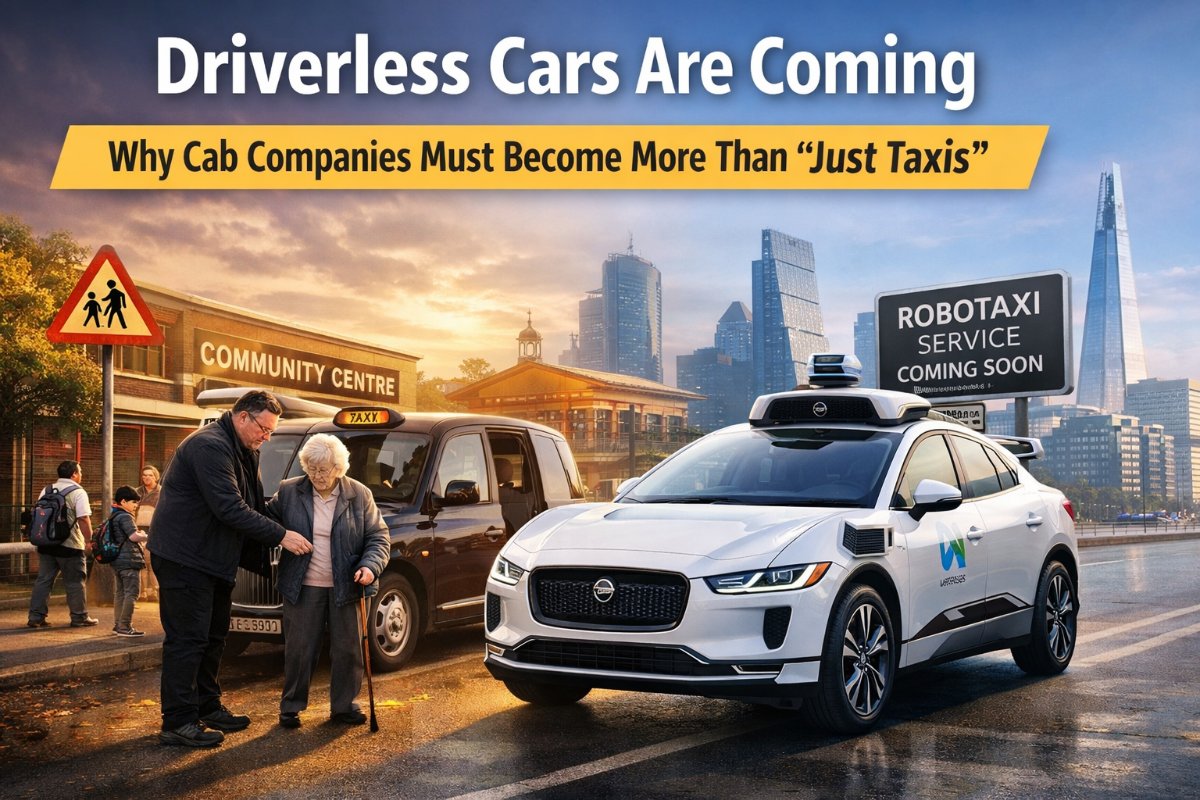
The Robotaxis Are Coming
Update, October 2026: since this article was written, TfL has licensed Uber and Wayve to run supervised robotaxis in London, with a trained driver on board. Read our latest news for more.
The writing is on the wall. Waymo, the driverless car company owned by Google's parent Alphabet, is gearing up to launch robotaxis in London as early as September this year. Uber and Lyft aren't far behind, both waiting in the wings with their own autonomous vehicles ready to roll out the moment regulations allow.
If you are a cab driver or run a cab company, this should be your wake-up call.
The UK government is fully backing this shift. Transport Minister Lilian Greenwood attended Waymo's launch event at London's Transport Museum, enthusiastically talking up the safety benefits of cars that "don't get tired, don't get distracted and don't drive under the influence." The government estimates the autonomous vehicle industry could pump £42 billion into the UK economy by 2035. Make no mistake - they want this to happen, and they're actively changing the rules to make it a reality.
So where does that leave traditional cab companies? Facing extinction, unless they're willing to adapt.
The Old Model Is Dying
For decades, the taxi business model has been beautifully simple: someone needs to get from A to B, you take them there, they pay you. Job done. But that simplicity is now a vulnerability.
Robotaxis can do exactly the same thing, potentially cheaper, running 24 hours a day without needing breaks, holidays, or sick pay. Waymo has already clocked up 173 million fully autonomous miles, mostly in the US. They have 1,000 robotaxis operating in San Francisco and 700 in Los Angeles. This isn't some far-off fantasy - it's happening right now, and it's heading our way. The harsh truth? If your only selling point is getting people from A to B, you're about to be undercut by a machine that never complains, never calls in sick, and never needs a pension.
Community Is Your Competitive Advantage
Here's the good news: there's something robotaxis can never offer. A relationship. A human connection. A sense of belonging to the community they serve.
The taxi companies that will thrive in this new landscape are those that stop thinking of themselves as transportation providers and start seeing themselves as community partners.
Think about it. Drivers know their local areas inside out. They know the elderly regular who needs help with her shopping bags. They know which school run mums are always running five minutes late. They know the local business owners, the shift workers, the hospital staff finishing at odd hours, and more importantly, as an experienced driver, you know when someone is reaching out for help and needs a friendly ear to offload to. That knowledge, those relationships - that's gold. And it's something a Waymo Jaguar with sensors and a computer in the boot will never replicate.
What Does "More Than a Cab Company" Actually Look Like?
So how do you turn this into a business strategy? Here are some ideas to get you thinking: Partner with local healthcare providers. The NHS is under enormous strain. Could your company offer reliable, caring transport for patients who need to get to appointments? Not just a ride, but a service where drivers are trained to assist those with mobility issues or anxiety about medical visits.
Support vulnerable members of your community. Could you offer discounted or subsidised travel for elderly residents? Partner with local councils on schemes to reduce isolation? Become the trusted name that families rely on to get Grandma to her weekly social club?
Work with local schools and businesses. Reliable school transport, corporate accounts with a personal touch, contracts with local venues and restaurants - these create steady income streams and embed your company into the fabric of daily life.
Become a visible community presence. Sponsor local sports teams. Support charity events. Get involved in community initiatives. When people see your name as part of their community rather than just a logo on a car, loyalty follows.
The Clock Is Ticking
Waymo's pilot launches in April. Regulations could change by late 2026. That gives traditional taxi companies a narrow window to reinvent themselves before the robotaxi wave truly hits. Yes, there will still be demand for human drivers - not everyone will trust a driverless car, especially at first. Stories of malfunctioning vehicles and trapped passengers will give some people pause. But relying on fear of new technology is not a long-term business strategy.
The companies that survive - and even thrive - will be those that give customers a reason to choose them beyond just the ride itself. They'll be the ones who've built relationships, earned trust, and become genuinely valuable to their communities.
A robotaxi can get you from A to B. But it takes a real person to ask how your mum's operation went, to remember you prefer the quiet route, to be a familiar face on a difficult day.
That's something worth paying for. But only if you start building it now