
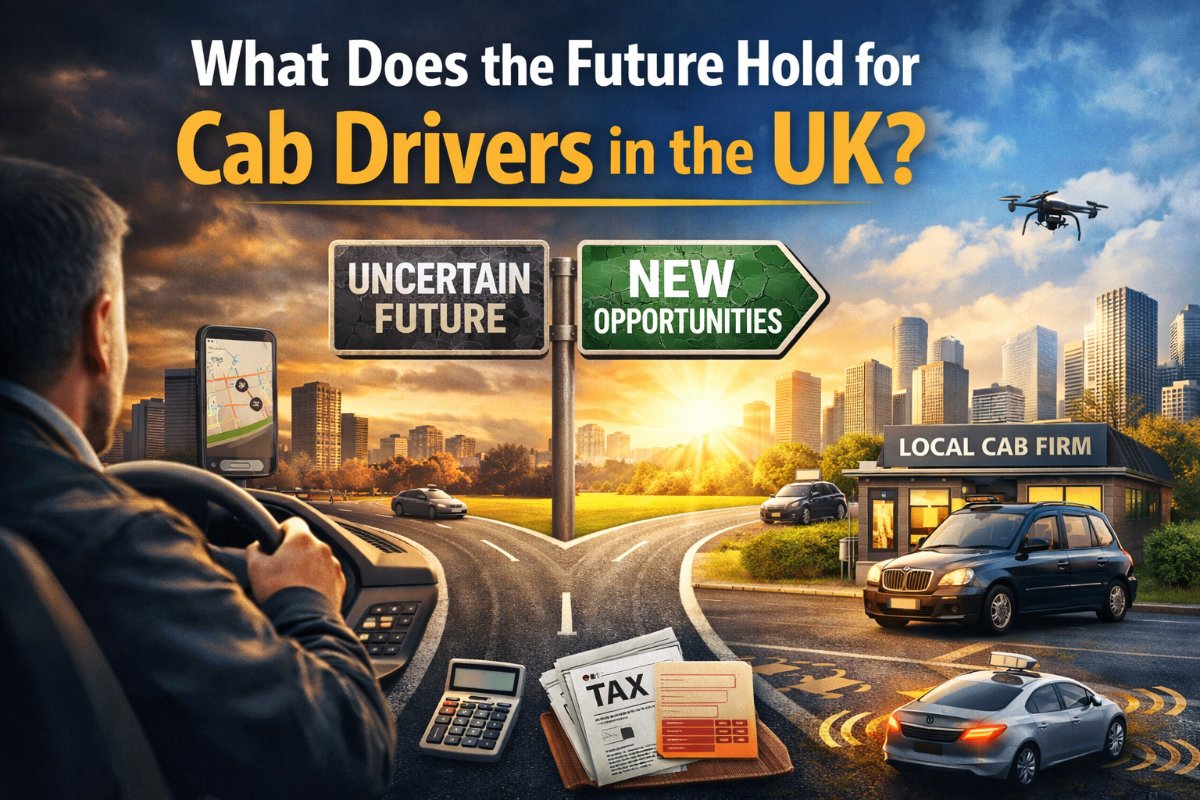
What Does the Future Hold for Cab Drivers in the UK?
Let’s be honest.
A lot of drivers are quietly asking the same question:
Is this still worth it?
Between rising costs, new tax rules, the growth of the big apps, and talk of driverless taxis — it can feel like the ground is shifting under your wheels.
So instead of pretending everything is fine, let’s talk about what’s really coming… and what you can actually do about it.
2026 Will Separate the Drifters From the Drivers
The industry isn’t collapsing.
But it is changing.
Drivers who “just log on and hope” will feel squeezed — just like any business owner without a plan or strategy.
Drivers who treat this like a business will survive — and have an opportunity to thrive as weaker operators drop out.
That’s the difference now.
Question 1: Do You Even Like Being a Driver Anymore?
This matters more than anything.
If you still enjoy:
- Being on the road
- Meeting different people
- Providing a good service
- Having flexibility
- Caring
Then you’ve still got something valuable.
But if every shift feels long…
If you resent passengers…
If you feel constantly stressed…
If you’re always talking about leaving the industry…
That’s a warning sign.
This job requires patience and professionalism. You are there to serve the public. If that mindset has gone, forcing it won’t improve your income.
Making Tax Digital (MTD): This Will Push Some Drivers Out
From April 2026, many self-employed drivers earning over £50,000 will need to keep digital records and submit quarterly updates to HMRC.
For organised drivers? It’s admin.
For drivers who throw receipts in a drawer and panic every January? It’s a problem.
Some older drivers may decide it’s not worth the hassle. And that’s understandable.
But here’s the truth:
MTD won’t ruin the industry.
Poor record-keeping will.
Drivers who treat this like a small business and keep clean, up-to-date records will adapt quickly.
The days of casual bookkeeping are over. The smart move now is to get organised and, if needed, work with a good accountant who understands the trade.
Doing nothing about it will, sooner or later, catch up with you.
Big Apps: Are They Taking Over?
Big platforms offer:
- Volume
- Flexibility
- Easy entry
- Immediate work
But they also bring:
- Commission changes
- Algorithm decisions
- Rating pressure
- Less personal connection
- Less long-term control
The real question isn’t “Are apps bad?”
It’s:
Are you building anything while using them?
If you rely 100% on one app with no plan, you are exposed.
If you use apps strategically — peak times, smart hours, controlled mileage — they can work very well.
Maximise your earnings by not putting all your eggs into one basket.
Local Firms: Can They Survive?
Some won’t — and many have already gone.
Let’s be real.
Local firms that:
- Ignore customer service
- Don’t train or support drivers
- Don’t engage with their community
- Compete only on price
- Don’t invest in marketing
…will struggle.
But strong local firms have something apps don’t:
- Repeat loyal customers
- School contracts
- Care work
- Business accounts
- Community trust
- Hospitality partnerships
- Strong reputation
And that trust still matters.
The future for local companies won’t be about being cheaper.
It will be about being better.
And that requires better drivers.
What Type of Driver Will Be in Demand?
Over the next few years, the drivers who stay busy will likely be:
- Reliable
- Clean and well-presented
- Calm under pressure
- Good communicators
- Professional at all times
- Door-to-door, not kerb-to-kerb
A local firm trying to build quality won’t tolerate:
- Rude behaviour
- Poor timekeeping
- Personal number swapping
- Reputation damage
- Doing the bare minimum
Standards are rising — not falling.
Should You Relocate?
In some areas, there are simply too many drivers.
In others, there’s strong demand and healthier margins.
Relocation isn’t extreme. It’s strategic.
If your area feels oversaturated, it might not be the industry that’s broken — it might just be your postcode.
Autonomous Taxis: Will They Take Your Job?
They are coming — but slowly, and in specific areas first.
Pilot schemes will start in controlled environments. Major cities will see them before small towns.
But here’s what people forget:
They won’t handle drunk passengers arguing about drop-off points.
They won’t carry bags upstairs.
They won’t reassure elderly passengers.
They won’t use human judgement when roads suddenly close.
They won’t offer a friendly ear or recommend somewhere good to eat.
Automation will affect parts of the market.
It won’t wipe out human drivers overnight.
The bigger threat isn’t robots.
It’s drivers becoming replaceable because they offer nothing beyond basic transport.
Just being average won’t be enough anymore.
The Hard Truth
The easy days are probably gone.
Fuel costs, compliance, competition — this is no longer a “turn up and earn” job.
But it is still a viable living.
If you:
- Track your numbers properly
- Choose platforms carefully
- Improve your service
- Align with the right company
- Treat it like a business
There is still money to be made.
If you drift, complain, and refuse to adapt — it will feel harder every year.
So What Does the Future Hold?
Not collapse.
Not extinction.
Not overnight automation.
It holds change.
And change rewards drivers who move early.
The question isn’t:
“Is the industry finished?”
The question is:
Are you prepared to evolve with it — and make yourself valuable?